About the Belerion Project
On other Pages
In preparation!
General resources:
Interesting Stuff
Useful reading:
The Belerion Project
A study and research group investigating earth energy and geomantic, psychoactive and psycho-spiritual factors in operation at ancient sites in the megalithic landscape of West Penwith, Cornwall.
The Full Proposal
Palden Jenkins, February 2025.
E-mail | palden.co.uk | Facebook | Blog |
A group project to investigate earth energy and the geomantic, psychoactive and psycho-spiritual factors in operation at a selection of ancient sites in West Penwith.
Starting hypothesis: megalithic sites were built to help ancient people work with subtle energy, consciousness and the deeper components of reality and human life.
In Penwith we have an opportunity to uncover something new and unique, based in our own experience here. It is a good area for such research in terms of size, ancient sites and interested people.
We seek to complement archaeological research with a wider spectrum of evidence and knowledge of a psi-research kind, and with a Cornish perspective.
This is about listening and letting the landscape and the spirits speak in their own tongue, being careful not to import or impose too many ideas or partialities, or romanticism or modern rationalism from outside.
The focus is on the culture of the Neolithic and Bronze Ages in Penwith – the Megalithic period between roughly 4000 and 1200 BCE, with some Iron Age inputs. They were pre-Celtic, pre-literate and pre-religious people.
It's about seeking to penetrate their thoughts, figuring out more about their aims, and understanding more about the knowledge that was available to them. This will have changed and developed over the generations and periods of the megalithic era.
The Proposal
Key aims
- to create a group research process and a body of comprehensive research results, eventually to produce a public-access website or report of value to the public and for the longterm.
- to observe, understand and learn more about the subtle-energy and psychoactive mechanics of how the megalithic system of Penwith actually works.
How?
By forming a group of people who are interested in working together to do this research over a period of time (such as an initial three years), in two ways:
- by meeting as a group for one day a month to do group fieldwork and group research, and…
- as individuals and in sub-groups, to pursue a variety of personal interests designed to contribute to the overall result.
A central core of people is needed, with a longterm and reasonably consistent commitment. This means keeping commitments doable in the longterm, and sticking to modest aims and objectives so that they are actually achieved. Success rests on a quorum of people who make it happen.
An outer group of people with less commitment can join in, but too many occasional helpers and too few committed regulars might make the project’s aims wander, and findings might lose consistency, or overall aims might not be achieved. Thus the group can perhaps only absorb a certain number of visitors and guests. Members need to live in West Cornwall and to have lived here at least one year (this is more important than it sounds).
This is not a course or training, though clearly a lot of learning and skill-development can result. Education needs to be a side-effect, evolved collectively through group sharing, and not a core aim. With dowsing or inner journeying, beginners and newbies can lack experience and practice in producing valuable results or identifying subtle differences between energy-frequencies and their interpretation.
The people who turn up and do the business are those who should set the parameters and membership rules and make the decisions. Once the project has started, new entrants might need a trial period: that is, turn up (say) three times, show consistency, and you’re in – otherwise, you’re ‘pending’, an associate but not a member. This will help the group to remain consistent in its aims and outcomes. Some meetings might be more open, some more closed.
Specific contributions can be made regarding mapping, digital work, sound-editing, coordination and baking cakes, doable at home. Some of these can be done by people less able to attend regularly (such as parents or the disabled).
At meetings, one person each month can perhaps offer a 20 minute sharing on their subject or where they have got to thus far, for the group’s benefit. There’s a study-group element to this.
Methodology
Two-pronged approach: each member plays a part in the group project as well as taking on a specific area of focus that interests them – such as the geology of stones, the orientations of landscape features as seen from sites, what each site feels like, or its traces of place-memory.
The group project involves agreeing certain basic parameters and topics at the beginning, so that a variety of researchers (such as dowsers or sensitives) seek the same things according to agreed parameters, so that results can be collated, compared and cross-referenced. Findings can be recorded as notes, audio or video, so that they can be compared to see where commonalities, corroborations and differences exist, and records can be kept. The aim is to produce a coherent record which will be useful to people in future.
For group site visits, here’s an idea. After arriving at a chosen site (try to avoid too much chatter), settle down and spend a silent 20-30 minutes meditating, inner journeying and ‘floating off’ together – a ‘fishing’ meditation. Then sit in a circle and, using a talking stick, pass it around so that everyone contributes in turn, for as long as it needs. This might start with a recounting of experiences gained during the meditation, but soon it might move into deep group discussion. It’s about giving the spirits or presences a chance to nudge or speak through us – potentially an inspired, intuitive, group deep-thinking process. (Sometimes the quieter ones come up with the most remarkable revelations – hence use of a talking stick.) If there’s a good note-taker present, that helps. Or an audio recorder can be used.
Suggested details to gather, record and tabulate consistently for every chosen site:
- the energy vortex or field at the site, underground water patterns, overground energy-lines;
- astronomical orientations, if they exist at that site;
- intervisible sites and prominent landscape features, and their azimuth angles;
- terrestrial alignments (as in the alignments maps);
- landscape setting and particular features;
- noteworthy characteristics of the site; make a map or an annotated aerial photo; take photos or videos for records;
- date-dowse for significant events at the site – its building, its peak(s) of use, its decline;
- an ‘inner scan’ (by, say, at least five people, together or separately, for comparison) for the qualities and atmosphere of the site, and anything that can be picked up to suggest its purpose or events that have happened there. Take notes.
Individual research
This can involve anything considered useful. What’s important is that it is systematic. If a person chooses to write poetry at each site, or do pencil sketches, it needs doing comprehensively, with a view to adding it to the overall research. It can then be compared with notes from other people who take psychic-intuitive readings, or make geomantic observations. It can be used as a component in the final presentation of the work. Much progress can be made by following the personal interests of members.
One key task is to pull together all the existing research that exists. Some of this is published (in books, online or Meyn Mamvro) and some is in the notes and scraps of former researchers. This might avoid wheel re-invention, give valuable prompts and recycle existing findings, also revealing gaps or new directions in the research.
Potential areas of focus are:
- underground water and overground energy-lines,
- astronomicals,
- design and geometry,
- alignments,
- geology and landscape placing,
- place memory and atmospherics at each site,
- inner journeying and psychometrically-derived impressions.
‘Data’ includes not just tangible, measurable items but impressions. Examples: “On a scale of 1-10, do you feel this site is relatively dormant today, or relatively alive?” Or: “Please visualise a typical day four millennia ago during the building of this site, to find how many people were involved, what the issues were that concerned them, and how they did it”.
We are dealing with non-tangible evidence with a large subjective component, but the idea is to make some sense of the impressions, imagery, ideas and experiences that do come up. To some extent we’re asking the sites and spirits to guide us and give us useful snippets to work on. Each participant should keep notes of their experiences, observations and findings for eventual sharing or collation – including observations they might not consider relevant.
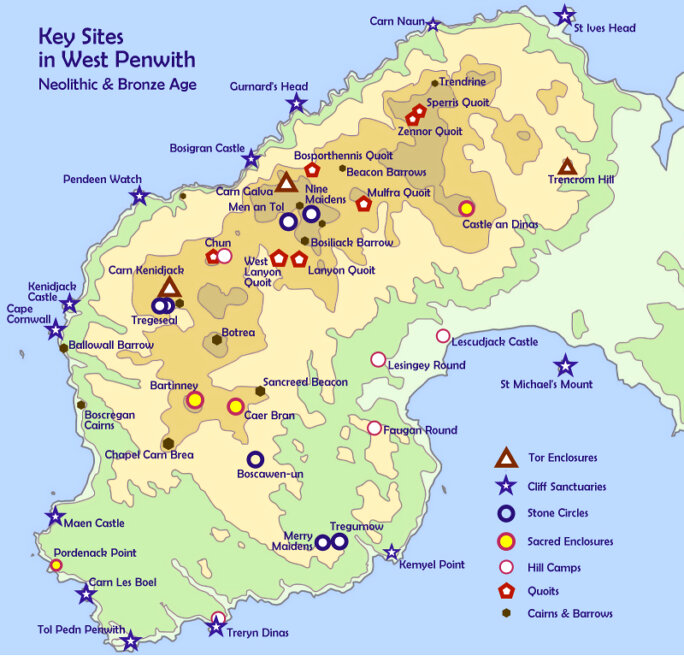
Here’s honouring the Cornwall Earth Mysteries Group of the 1980s-90s for their pioneering work in Penwith - a forerunner of this project. Also local archaeologists David Giddings and the late Craig Weatherhill, who each observed that Penwith could be one integrated system – for them, it was more a suspicion than something they could find archaeological evidence for. I (Palden) came to this idea by looking at the patterns of alignments – through studies outside the realm of archaeological acceptability. But when various people come to a similar idea by different pathways, something is going on.
NEXT: Notes & Suggestions
Or: Penwith's Sites
Privacy. This site uses temporary cookies to watch general trends only. We aren't selling anything, capturing, mining, passing on your data or making mailing lists. It's a public service - no strings. Any issues, please make contact.