Energy Centres and Ancient Sites
Energy Centres
It all rests around power points - energy centres.
Boscawen-ûn stone circle, a geomantic masterpiece
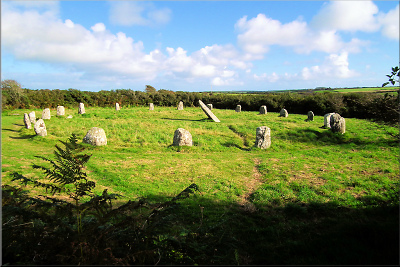 Today, that is what we seek, consciously or unconsciously, when we visit ancient sites, and the same was the case in ancient times. We seek to bathe in an energy-field.
Except ancient people didn't just visit - their sacred sites were central, functional and important to them. Similarly, hospitals, power stations and banks are important to us.
Each ancient site has a unique character, atmosphere and presence, fitting in with its environment and very much part of it. Some were major, focal places, others had special qualities, and some were of immediate local significance. This was a nature-sympathic technology.
Some sites were less important though they played their part - typically cairns and menhirs. Sites such as these helped crank up the energy at major sites.
They were energetically, ecologically and geographically significant in their immediate vicinity too, within their own local landscape setting.
Consider the Penwith system as a wholeness, a landscape-wide infrastructural eco-etheric engineering project. Penwith's cliff-bound, ideally-sized, geologically crystalline peninsula was a good place for it.
All sites, big and small, contributed to the overall system. The system was built to refine and amplify the energy-vibrancy of Penwith - to make it shine and hum.
It probably had a wider effect, as one in a string of megalithic areas stretching from Brittany to Scotland, through Ireland and the west and north of Britain.
The re-erected menhir on Carn Eanes

Energy and Form
Many sites have a distinctly strong, palpable and atmospheric feeling to them - and they vary greatly in quality and tone.
Kemyel Point off Lamorna Cove - a natural power-point
 Here are key four working hypotheses in geomancy:
1. Most or all ancient sites are located where they are because of the inherent natural energy-qualities of that place - earth energy and genius loci or 'spirit of place'.
2. The construction of stones or cairns on a site was done to enhance, entrain and harness those energy-qualities - to give the place an upgrade.
3. Place memory - this is the energy-field or memory traces of things that have happened and been done at that place, and of people who have been there over time. Over multiple generations, prayers, invocations, chorals, healings and ceremonies leave their mark, as also do less savoury events occurring throughout history.
4. Megalithic science. Particularly in the Bronze Age sites were constructed for quite theoretically-based reasons, to provide links between other sites, mark soli-lunar rising and setting points, amplify the circuitry of the system or fulfil arcane sacred-geometrical, mathematical and cosmological aims.
Below: Newly rediscovered and re-erected menhir at Treryn Dinas (Treen Cliff)
When discovered in 2019, it was found that it lay at the intersection of two exact alignments,
one to Lesingey Round and Castle-an-Dinas, and the other to Boscawen-ûn, Lanyon Quoit and the Nine Maidens.

The building of the system started with natural 'base sites' - places with strong earth-energy fields and spirit of place before humans came along. These natural sites were consecrated and enhanced by shaping and building on them - it started with placed stones on Neolithic tors and with building quoits.
Then, particularly in the Bronze Age, there followed sites which were more man-created, located in less glaringly obvious places.
They were however usually plugged into weaker energy-fields to utilise or upgrade them, or they had particular landscape qualities such as a vista or a well-placed setting, or they were placed in relation to other sites.
These sites acted as connectors, relays, terminators and proxy sites, playing a linking role in the wider network.
It is likely that major sites such as quoits, stone circles and certain barrows can be located only on pre-existing natural energy-centres, or 'base sites', while other sites such as menhirs and many barrows are located according to looser principles, drawing energy to them or amplifying existing energy-vortices to upgrade them.
The overall aim was to raise the voltage, energy and efficiency of the overall system, infusing the Penwith peninsula with potentised energy. In a sense, West Penwith was one big ancient site.
Below: Chapel Carn Brea as seen from Caer Brân
Chapel Carn Brea is the last hill in Britain, with Neolithic and Bronze Age barrows on top. See it on a map.

Ancient sites are established in connection with localised concentrations of subtle energy, which create reality-fields and consciousness-bubbles. This is fundamental. A reality-field is the space at an ancient site where everything feels different - it can give a feeling of being at the centre of everything.
Without this, few plausible reasons can be found as to why the ancients went to so much trouble to build their sacred sites.
Understanding subtle earth energy is an area where modern science and archaeology choose not to tread. This represents an important evidential gap in their analysis of ancient sites, and in public knowledge.
A fundamental principle in geomancy involves subtle energy, dimensions of reality, consciousness and the intelligence within nature. One purpose of ancient sites was to work with energy and consciousness to infuse nature and reality with an amplified kind of order.
Prehistoric people developed a deep-rooted form of civil engineering which is suggested, here on this site, to constitute of large-scale geoengineering project aiming to affect the natural environment, the climate and the fortunes of humans.
Since this civilisation lasted over a thousand years, they must have been getting something right. Though in the end they were incapable of overriding the fundamental first law of history: all things must pass.
Privacy. This site uses temporary cookies to watch general trends only. We aren't selling anything, capturing, mining, passing on your data or making mailing lists. It's a public service - no strings. Any issues, please make contact.