The Spirit of Place
Genius Loci
The placing of ancient sites
Spirit of place is a difficult notion for rational thinkers, but it's real nonetheless. It was pretty much the key factor in the location and design of ancient sites - the subtle atmospheres that are present there.
Ancient sites in West Penwith are located where they are for a range of interlocking reasons. Here are some of the known factors that influence their location.
Carn Galva, 5m away, from The Pipers near the Merry Maidens
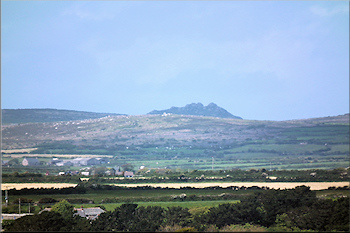 Genius loci or spirit of place is something that is natural - you can feel it at special places such as waterfalls, woodland glades or hilltops simply by dint of the atmosphere that is there. It is a spirit, a presence, an innate character or vibe, with its roots in nature and subtle energy, super-concentrated in certian places. The ancients sought to amplify this or even create it - just as you might do in a corner of your garden.
Placeness - a sense of certain places being special - is partially endowed or projected on a place by humans, as a result of the memories, significance or symbolism people might give it. Partially it can be inherent to a place - and this specialness is amplified by building a quoit, stone circle or other geomantic construction precisely at that spot. There's something deeply aesthetic and harmonic about it.
Here we come to a sense of presence at a place, a feeling that something is there - a spirit, an energy-field, a feeling that something particular and special is there. Call this subjective, but there is more to it. In some places (such as Boscawen-ûn, Carn Lês Boel or Sancreed Well), there can be a calming, stirring, surreptitious sense of peace, character, aliveness or intensity which, at times, can be knee-shakingly noticeable - especially at the 'right' time. Timing is a factor here.
The whole peninsula of West Penwith is like this, in comparison to many places upcountry: when approaching Penwith you get a distinct feeling of entering somewhere different, a rather magical land.
Some of the factors that contribute to the generation of such atmospheres at ancient sites are outlined below. These create conditions where such a presence becomes more tangible. The veils or thresholds between levels of reality become thinner there. Deeper levels of awareness come closer to the surface of consciousness. Usually you feel better, happier, or insights come, or something in you relaxes and lets go, and a smile comes to your face.
Several factors affect the location and design of ancient sites. Here's a lowdown.
Underground Water-flows
The Merry Maidens
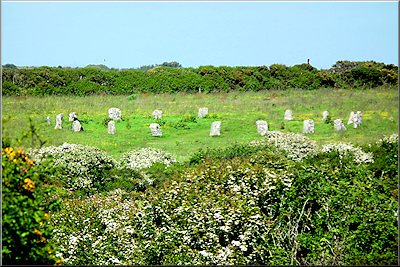 Blind springs (water domes) are deep up-welling underground water-flows and seepages that hit an impervious rock layer below the surface and then spread out more or less horizontally and radially from that point.
These underground water-flows are detectable by dowsers by dint of the subtle energy-fields created by them, spreading out radially and in spiral, toroid or other patterns that are detectable on the surface of the earth. Different dowsers pick up different things, but their findings are usually congruent in some way.
One special quality of blind springs is that they have an effect on consciousness. This is one reason why stone circles and chambered cairns are located above them.
The test for this is simply to spend time at a stone circle or a cairn, letting yourself freewheel in your thoughts or meanderings, and observing how your concerns float away and how creative or insightful insights often arise.
When you leave, you'll be in a detectably different state to when you arrived - and more so than you would experience in a more normal natural setting. You'll feel clearer, healed or happier.
Subtle underground energy-patterning is a big factor in the location of standing stones, cairns and particularly stone circles. As far as we know, all stone circles have a blind spring underneath them - at varying depths, often of 30-500m.
Sites such as standing stones and cairns are often located over the crossing points of underground water lines - subterranean streams, trickles and seepages moving through fissures and porous areas of rock below.
These create what dowsers and sensitives regard as a vortex or whorl of subtle energy at ground level. Sites are located to mark, peg down, amplify or train flows of this 'earth energy'.
Dowsers offer an important evidential input by which to understand ancient sites.
The Visible Landscape and Intervisibility
Carn Galva from the Nine Maidens
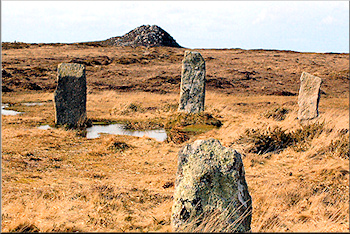 The Britons of ancient times had their own form of feng-shui or landscape architecture. They placed sites in locations where the view or the presence of surrounding landscape factors were key issues. Both Tregeseal and Nine Maidens stone circles are overshadowed by prominent tors, Carn Kenidjack and Carn Galva, and the tors form a scenic backdrop to the stone circles.
Since the tors were the holy places of the Neolithic 3000s, and probably before, this gave the newer Bronze Age sites built in the late 2000s, such as the stone circles, a rooting in heritage and the lineage of the ancestors.
There was a landscape artistry to this, and to the building of a poetic and mythic psycho-geographical landscape, stuffed with character, history, hidden significance and spirit beings. So with many (but not all) ancient sites, their visual placing in the landscape can be important, sometimes outstanding.
At some locations you'll perceive a remarkably level or proportioned horizon, even if surrounded with hills, as at Tregeseal. At others, a special view will be visible that is unique to that place, and which is lost as soon as you move away from it.
Carn Kenidjack from Bosiliack Barrow (telephoto)
 There's intervisibility too - seeing other sites from any site. For example, from Bosiliack Barrow, which is not placed on a high-point, you can see Watch Croft (Penwith's highest hill), Chûn Castle (hill camp), Carn Bean (barrows), Carn Kenidjack (Neolithic tor), Botrea Hill (barrows), Bartinney Castle (enclosure) and Sancreed Beacon (cairns). This is brilliant placing. Having a visible connection with other sites is important at many but not all sites.
Chûn Quoit from Boswens menhir
 Some sites sit on top of a hill (such as Bartinney Castle, Botrea Barrows or the cairns on Chapel Carn Brea) while others might be deliberately located on the side of a hill so that, when seen from another site or location, they stand out on the horizon. This is called a 'false horizon'
This is the case for the menhir at Boswens, which can be seen from Tregeseal stone circle; or Chûn Quoit as seen from Boswens (see picture); and for the menhir and cairn on top of Watch Croft, as seen from the Mên an Tol stone circle down below it.
Mulfra Quoit from the Nine Maidens (telephoto)
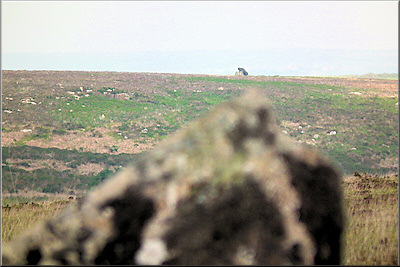 If you stand at a site like Mulfra Quoit and swing around to survey the landscape, you'll see an array of different sites and hills, some of them quite remarkably placed in relation to Mulfra. It's rather magical. The builders of Mulfra Quoit definitely engineered this by placing the quoit precisely where it is.
Sometimes, when approaching an ancient site, you might wonder why it is located precisely where it is. Then, when you arrive a vista or a visual setting appears that suddenly makes sense, specifically at that precise location. If you move a short distance away this panorama or perspective can disappear. So this siting business is at times really carefully calculated.
Carn Kenidjack from Carn Lês Boel (telephoto shot)
 Just above Carn Lês Boel, on the landward side, there is a small cairn that you can stand on, and Carn Kenidjack, some five km away, becomes visible - but move just a few yards off the cairn and it's gone. Again, specially engineered. However, this sightline is visible one way only, from Carn Lês Boel toward Carn Kenidjack, not in the other direction.
Archaeoastronomy
The rising and setting points of the sun at the solstices and other key times of year such as the cross-quarter days, and those of the moon at its major and minor standstills, are important factors in the design and location of some ancient sites.
It probably applies also to the visible planets, but they follow more or less the same course as the Sun across our heavens, along the ecliptic, so it is impossible to tell whether their paths were specifically built into ancient sites.
Some sites are oriented toward such rising and setting points (such as the direction of the chamber in a chambered cairn, sometimes oriented to the summer solstice rising point). At other sites a distant menhir, a hilltop or a feature on the horizon marks such a rising or setting point. The site was placed where it is for this to happen.
Summer solstice sunset as seen from Trencrom Hill
 So the location of some sites was based on the viewing of rising and setting points. For example, from Chûn Quoit, the summer solstice setting sun sets in a nick in the summit profile of Carn Kenidjack, a kilometre away.
From Trencrom Hill, the summer solstice sun rises over St Agnes Beacon, up the coast, and it sets in a nick between Trink and Rosewall Hills northwestwards, exactly following the incline of Trink Hill until it sets (see picture).
The Mythic and Cultural Landscape
Every landscape feature had its own narratives, history and beliefs attached to it by humans. These beliefs and mythologies often have some relevance to the nature of the site. Some prominent hills such as Carn Galva, Trencrom Hill or St Michael's Mount were regarded as the homes of giants, for which traditional tales of their antics still exist today.
If I say "St Michael's Mount" to you, you will not only have an image of the Mount in your mind's eye, but also a bundle of impressions, associations, memories and narratives attached to it, some of them personal to you and some held collectively.
Trencrom Hill behind, Gull Rock in front. Taken from Porthtowan
 Our perception of an area is still influenced by traditions, stories and associations today - about someone who lived there or something that happened - and this was the case for ancient people. Theirs was a magical landscape infused with presences and significances, and this wasn't just the fantasy of primitive people. Those beings are there. The ancients lived in a world where things went bump in the night.
It was a magical perception with substance to it, that we need perhaps to reclaim now, to heal ourselves of a tendency to exploit and destroy nature, exorcising the landscape of its spirits, its specialness and its holiness. It's a loveless condition that sees nature as a resource, a threat, or a property, with no emotional or imaginal content.
Ancient sites, with their special atmospheres, attract associations, mythologies, events and experiences both actual and numinous. Places have identity, and 'strong' places have characteristic atmospheres and resident presences - genius loci.
Reality Fields
At some ancient sites, it feels as if you're at the centre of things - as if the world rotates around it - it's a focus of hereness.
Awareness has gravity-centres, and we can regard this as a kind of gravitational 'reality field' - a bit like a magnetic anomaly, except a consciousness anomaly. If you walk round a magnetic anomaly with a compass, the needle will usually track the anomaly and forget magnetic north.
There is sometimes even a slight pulling feeling when one approaches an ancient site.
The ancient Greeks called this an omphalos, literally meaning a navel. It is an umbilical connection to something deeper.
Whatever this reality field is, it is one of the things that pulls us to visit ancient sites. When we get there, it's good to settle down, float off and be inside it for a while, to imbibe the atmosphere, putting ourselves into a listening or receptive mode. Remember to take the key ingredients in a geomancer's essential kit - a flask of tea and a flapjack.
Alignments
Virtually all ancient sites are placed exactly in alignment with other sites - often four or more sites on one alignment. The system of backbone alignments in particular is anchored to natural features such as tor hills and coastal headlands (cliff sanctuaries), and these alignments determine the location of major sites such as stone circles.
In Penwith the stone circles were built in alignment with pre-existing natural sites such as Neolithic tors and cliff sanctuaries - whether or not they can be seen from that place. These focal sites peg down the complete system of ancient sites in Penwith. Subsequent or subsidiary sites are built in alignment with these - they are derivative sites, at least in terms of alignment.
Why exactly the megalith builders aligned sites to each other remains a mystery, but they did do so, investing great effort and accuracy in it. More about alignments here.
Mathematics and Geometry
In other parts of Britain geometrical patterns, locational relationships and shapes have emerged in the way that ancient sites are located, and this is true in West Penwith too. This question has not yet been properly studied here. It awaits someone to come along with the right kind of brain and motivation to do it!
Bundles of Purposes
Many ancient sites are located where they are for a number of subtly combined reasons. Sometimes it is not immediately visually obvious why a site is where it is.
Chûn Quoit, Carfury menhir or the Merry Maidens are examples: why do they sit on the sides of hills, in places that aren't outstanding in terms of placing? Other sites are more obvious in their placing, right on top of hills - Lesingey Round, Chûn Castle or Castle an Dinas being examples.
But somehow, all of the factors mentioned on this page knit together into a wholeness that determines the location and patterning of ancient sites. This is quite remarkable - sites might have underground water, alignments, astronomicals and intervisibility as contributory siting factors, and what's remarkable is how they seem to interlock. Every site has a uniqueness to it, yet in an organic and intuitive way it follows similar rules to other sites. Usually a site exists not only for one single reason.
When you visit, it's good to go quiet, imbibing the feeling of a place, listening, hearing and seeing what it has to teach. Switch off your phone. Look for day-signs - things that happen while you're there, such as birds flying overhead, cloud patterns or rustlings in the undergrowth. What you 'get' isn't 'just imagination' - you can pick up on something from the place-memory or the innate identity of the site, its genius loci or spirit of place.
The Purpose of Ancient Sites
Mulfra Quoit from the Nine Maidens stone circle
 Mounds (cairns and barrows) sometimes show signs of use for storing the remains of the dead, but this does not mean they were built for burial. Later in history, churches were surrounded with graveyards, though they were built to be houses of God - hosting the graves of the dead was a secondary matter.
Medieval saints' relics were held to have spiritual-magical powers - they were revered, and people made pilgrimage to be near them.
In ancient times the bones of a great ancestor would be kept and used as a way of talking to the ancestors or the tribal soul, and they would serve as sources of guidance, blessing or as symbolic objects of eternity or deep identity. Often such great ancestors were buried mounds with cists, located in special places such as clifftops or hilltops, to bless and protect the land.
Archaeologists tend to place undue weight on ancient burial practices, thereby missing other, more important, reasons why cairns and barrows were built. It is assumed that, since some mounds had burials and bones, all mounds must serve a funerary purpose. Not true. This is a bias.
In the 1960s-70s dowsers Guy Underwood and Tom Graves came up with the observation that mounds acted as energy batteries for the accumulation and release of subtle energy, or as energy buffers playing a part in a larger geomantic system.
Standing stones and stone circles, meanwhile, served as conductors or antennae connecting the land and the heavens - like acupuncture needles. From an energy-engineering viewpoint, this makes these sites far more plausible and meaningful.
It would be wonderful to be able to read the minds of Neolithic and Bronze Age people, to understand what was in their thoughts when building such a large number of sites as we see in Penwith, but we cannot - we can only see the signs and remains of what they did.
There can be a tendency to impose on ancient sites ideas and worldviews that come from modern times. The question of subtle energy and megalithic locational science is central to understanding megalithic remains, geomancers would say.
But, since we moderns largely don't perceive subtle-energy impressions, and in many cases don't want to, subtle energy does not and cannot exist, and thus ancient sites can have no such connection or significance. It's simply woo-woo and hocus-pocus, and that wraps the matter up. Except that this is a time-limited belief, and all things must pass - eventually.
Privacy. This site uses temporary cookies to watch general trends only. We aren't selling anything, capturing, mining, passing on your data or making mailing lists. It's a public service - no strings. Any issues, please make contact.