Penwith's Ancient Sites
Penwithian Megaliths
Carn Kenidjack - a Neolithic tor enclosure from the earliest times
 The megalithic era in West Penwith spanned more than two millennia - a hundred generations. It comprised two main periods of development.
The first was in the mid-Neolithic, between about 3700 and 3200 BCE.
The second was in the Bronze Age from around 2500 to around 1500 BCE, with its final end around 1200.
These two phases were quite different but they worked according to similar principles, born in the Neolithic and further developed in the Bronze Age.
The Neolithic | 3700-3200 BCE
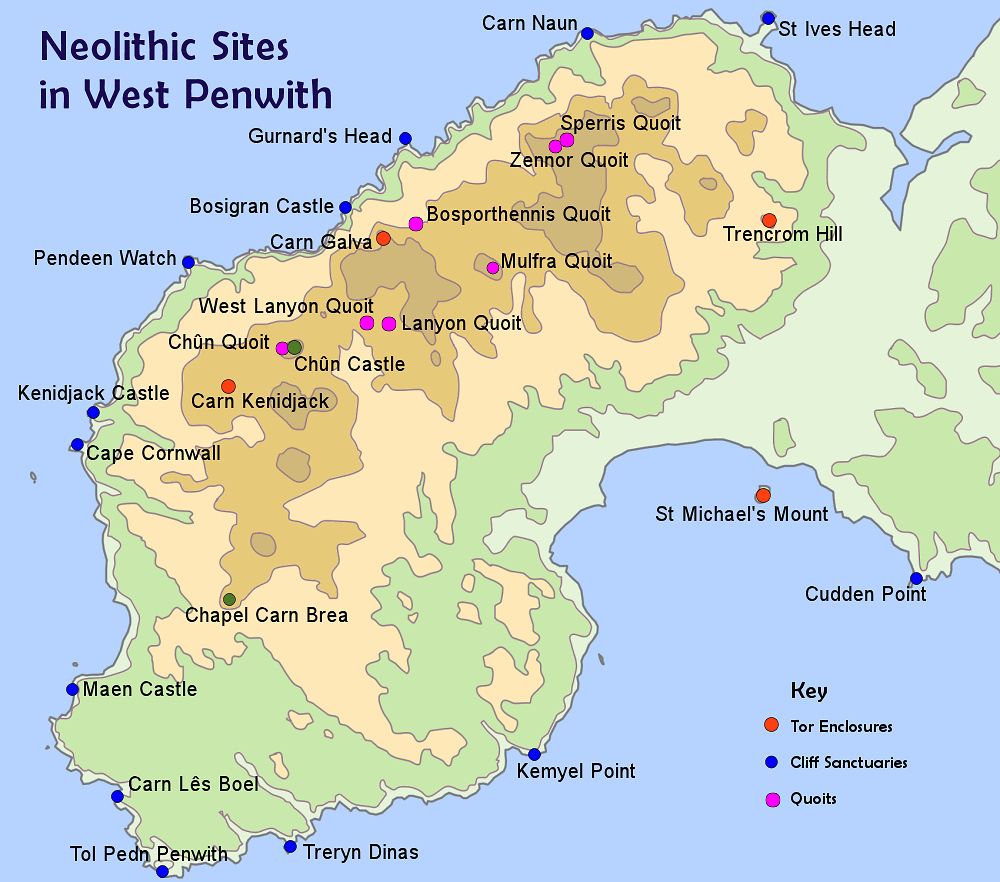
Tor Enclosures
They were the main meeting and magical places, where people could get above the forest and see the sky.
The tor sites were at St Michael's Mount, Trencrom Hill, Carn Galva and Carn Kenidjack.
There were also notable Neolithic hilltop sites at Chûn Castle, Chapel Carn Brea and Zennor Hill.
Cliff Sanctuaries
Kemyel Point, Lamorna, an unrecognised cliff sanctuary
 Important to Neolithics were the cliff sanctuaries (cliff castles). They form a necklace of consecrated headlands enclosing and 'holding' the peninsula. The geomantic pattern of Penwith is pegged down by the cliff sanctuaries.
In the Neolithic, these were consecrated places where people could leave the forest to experience the wide sweep of the world. Each had a different character, feeling and value.
Archaeologists identify the boundary 'ramparts' of what they call 'cliff castles' as Iron Age in origin (500 BCE to CE 100), reckoning that the cliff sanctuaries started their careers then as defensive positions. Not so - they were used and valued in the Neolithic, serving as significant sites in Penwith. This is explained here.
Chûn Quoit - still intact
 Quoits
The most remarkable megalithic constructions of this time were the quoits (cromlechs or dolmens).
These were the trickiest and most advanced constructions of the whole megalithic period, involving the raising of enormous multi-ton capstones. Keeping them intact during transportation would have been a big challenge.
All of them were located in the northern, upland part of Penwith, which was the centre of human activity in Penwith in the Neolithic 3000s.
Quoits were not tombs: they were energy-chambers for working with the energy-patterns of the wider landscape, serving also as repositories that were used to give energy-treatments to objects, tools, crops and medicines, and possibly used as initiatory places too.
Erected Stones
The Neolithic also saw the erection of placed, propped and oriented stones. Many (though not all) of these come from the mid-3000s BCE.
Treryn Dinas, with a likely placed stone on top

Placed stones were rocks that were moved short distances - sometimes only a few yards - to install them in interesting, often rather artistic locations. This is an early form of sympathetic nature-enhancement.
A classic neolithic propped stone on Zennor Hill

Propped stones were raised up, often at one end, with one or a few small stones placed underneath them to keep them raised.
Oriented stones at Carn Trevean near Carn Lês Boel

Oriented stones had at least one flattish edge, dug into the ground to stand vertically, with the flattish edge oriented toward another site such as a hill or a headland. This highlights that feature or creates a link between the place where the rock stands and the place it's pointing at.
The Bronze Age | 2500-1200 BCE
Carfury menhir

Around 2500 BCE, things started changing. The indigenous culture of the Late Neolithic developed new ideas and a new pattern of ancient sites started appearing across Britain and Ireland.
New people entered Cornwall from Brittany and Iberia, bringing ideas, copper and, later, bronze working. These new influences merged with indigenous ideas to shape the Bronze Age.
The Merry Maidens
 Over the following centuries a profusion of stone circles, menhirs, cairns and barrows, hilltop enclosures and other sites were built.
Principles pioneered in the Neolithic were further developed, with more science and system involved. A complex integrated system of sites was built up across Penwith over the generations and centuries.
The Neolithics had intuitively located their sites on top of energy-vortices generated by blind springs and intersections of underground water lines, as well as making use of astronomical, landscape and other factors.
The people of the early Bronze Age turned these principles into a large-scale project eventually covering the whole Penwith peninsula.
Mên an Tol - formerly a stone circle
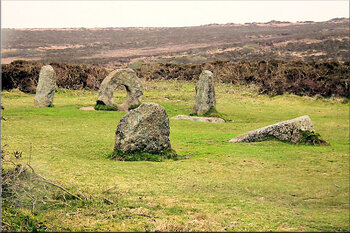
A key geomantic principle involved accurately aligning sites to each other - some over long distances. Aligning them made them work in sync with one another (a bit like 'quantum entanglement'). These were not isolated sites, but they were developed as an integrated system.
To examine this, in the 2010s a map was made of all the identifiable alignments found in West Penwith - it's here.
All of the alignments on the map (with a few exceptions) are accurate to within just three metres, on alignments stretching many miles. They are easy to check and solidly evidential. Their capacity to shed light on the purpose and meaning of megalithic sites is enormous.
Privacy. This site uses temporary cookies to watch general trends only. We aren't selling anything, capturing, mining, passing on your data or making mailing lists. It's a public service - no strings. Any issues, please make contact.